Showing posts with label regenerative medicine. Show all posts

Thursday, March 14, 2013

Stem Cell Advance: Brain Cells Inserted in Monkey Brains

Researchers at the University of Wisconsin-Madison are reporting a significant step forward toward the day when stem cells may be used to treat brain diseases such as Parkinson’s.

Working with three rhesus monkeys, the research team created a personalized stem cell culture for each monkey.  Cells taken from the skin of the monkey were induced to a state of pluripotency by means of a process called “induced pluripotency.”  Once in a state of pluripotency, the cells were guided forward in the process of differentiation until they became neurons and glial cells.  Along the way, the cells in the culture were given a genetic tag so the cells would glow under a florescent light. 
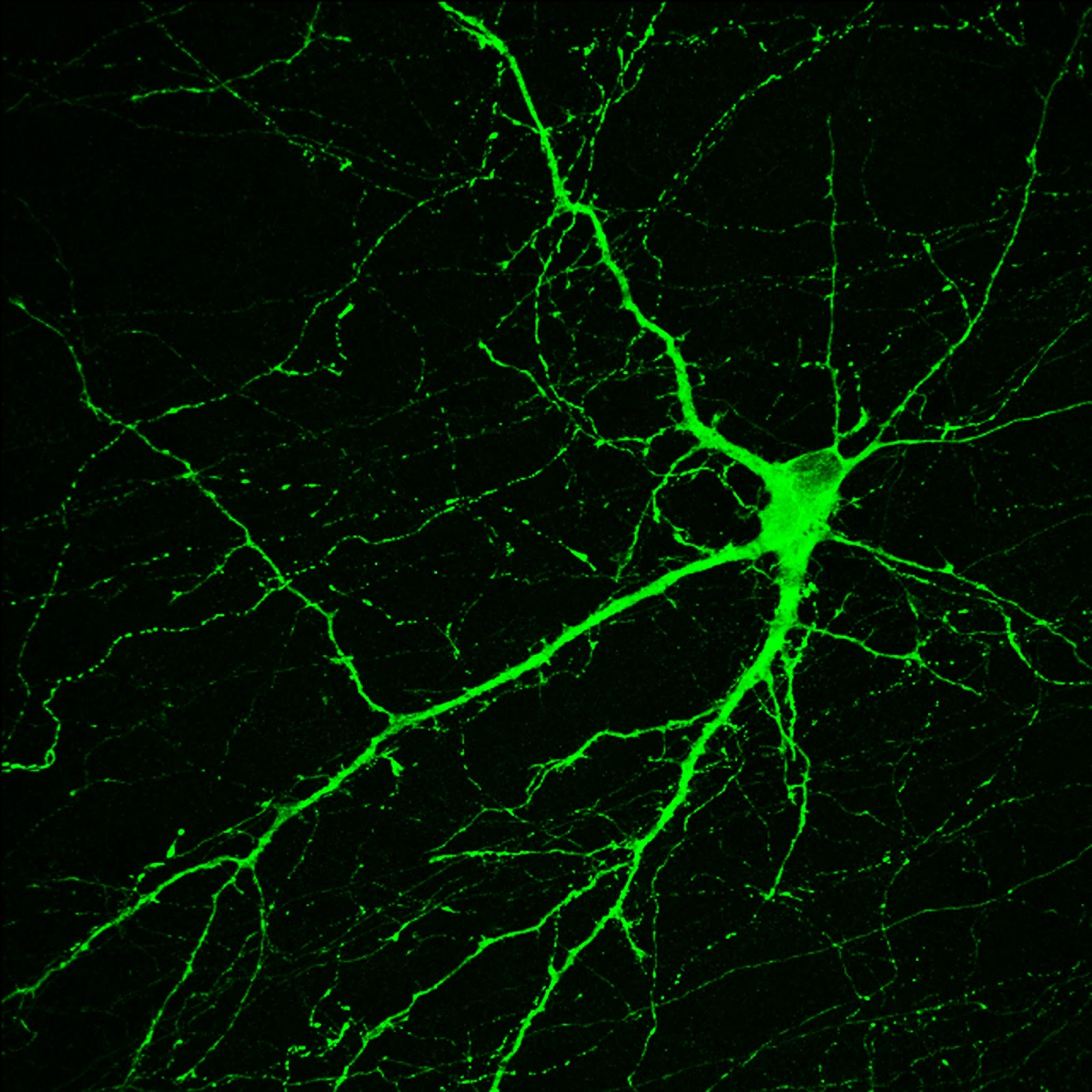
Then the cells were implanted in the brains of the rhesus monkeys.  Because the source of the cells was the monkeys themselves, the DNA matched and there was no immune reaction.  After six months, researchers discovered that the cells were so fully integrated into the monkey brains that in many cases, they could only be recognized by their green florescent glow.

"When you look at the brain, you cannot tell that it is a graft," says senior author Su-Chun Zhang, according to a press release from the University of Wisconsin. "Structurally the host brain looks like a normal brain; the graft can only be seen under the fluorescent microscope." 

Caption: This neuron, created in the Su-Chun Zhang lab at the University of Wisconsin–Madison, makes dopamine, a neurotransmitter involved in normal movement. The cell originated in an induced pluripotent stem cell, which derive from adult tissues. Similar neurons survived and integrated normally after transplant into monkey brains—as a proof of principle that personalized medicine may one day treat Parkinson's disease. Date: 2010.  Image: courtesy Yan Liu and Su-Chun Zhang, Waisman Center, University of Wisconsin–Madison.

The three monkeys involved in the experiment were given tiny lesions or scars in their brain to mimic Parkinson’s disease.  Another lead researcher, Marina Emborg, commented on how the inserted cells integrated themselves into the brain.  “After six months, to see no scar, that was the best part."


What makes this work significant is that it is the first use of induced pluripotent stem cells (iPS) involving a primate, setting the stage for further work someday involving human beings.  According to Zhang, "It's really the first-ever transplant of iPS cells from a non-human primate back into the same animal, not just in the brain," says Zhang. "I have not seen anybody transplanting reprogrammed iPS cells into the blood, the pancreas or anywhere else, into the same primate. This proof-of-principle study in primates presents hopes for personalized regenerative medicine."

One of the keys to their success is that the iPS cells themselves were not transplanted into the monkeys.  Because iPS cells are pluripotent, they can give rise to cancer or other problems.  In this work, the researchers carefully guided the iPS cells so that they were almost at the final stage of differentiation, and then made sure that their cell culture was completely purified so that no potentially cancer-causing cells would slip through.  Quoting Zhang once again: "We differentiate the stem cells only into neural cells. It would not work to transplant a cell population contaminated by non-neural cells."

Because of these precautions, the experiment succeeded in introducing new cells into the monkey’s brains without any obvious problems.  But in this experiment, too few cells were introduced to help the monkeys overcome the symptoms of Parkinson’s.  Solving that problem is the obvious next step.

According to the paper, “this finding represents a significant step toward personalized medicine,” which may someday be used to treat a wide range of diseases in humans.  Because the original source of the cells was from the individual monkeys themselves, there was no immune rejection.  If the same technique can be applied to human beings, it may mean that an individualized culture of iPS cells could be created for each patient, then carefully guided forward in the process of differentiation, and then implanted to regenerate organs or tissues damaged by injury or disease.

What makes iPS cells especially attractive is that no embryos are used in their creation, and so almost no one objects to this line of medical research.  But if regenerative medicine is successful, someday it will be used not just to treat disease but to off-set the effects of aging or to enhance those who are well.  Then, we can be sure, many will object to this technology, but even more will use it.

The article, entitled “Induced Pluripotent Stem Cell-DerivedNeural Cells Survive and Mature in the Nonhuman Primate Brain,” is freely available at the open access journal, Cell Reports in its March 28, 2013 issue. 


Monday, February 13, 2012

Regenerative Medicine: Repairing the Heart

A breakthrough in the use of stem cells for regenerative medicine has just been reported by researchers at Cedars-Sinai Heart Institute. Patients who suffered heart attacks were implanted with cells derived from their own hearts. Some of the scars left by the heart attacks dissolved and new heart muscle cells re-grew, according to a report in the February 14 issue of The Lancet.

Patients involved in the study had all experienced recent heart attacks that damage heart muscle. The first step in the procedure involved inserting a catheter through a vein in the neck under local anesthesia. Using the catheter, researchers withdrew a small sample of healthy heart tissue. The tissue contains some stem cells, but the key step in the procedure is to multiply and purify the small number of stem cells so that they number in the tens of millions.

These cardiac stem cells, multiplied but originally from the patient’s own heart, were then infused back into the site of the heart attack. The result seems to be a nearly 50% drop in the size of the scar and a re-growing of healthy heart muscle, at least as far as could be determined using imaging technology.

It is important to note that this study is a Phase I clinical trial. Its main purpose is to show that there is no unwarranted risk in the procedure. The outcome of this trial, however, shows a real likelihood of benefit. The evidence is strong that scaring is reduced and heart muscle regenerated. It is too soon, of course, to know the long-term benefits.

What is new in this study is the strong likelihood of actual regeneration of heart cells. Whether the implanted cells produced the new muscles or whether they acted indirectly, triggering neighboring cells to divide and regenerate tissues, is still not clear.

The lead researcher in the study, Eduardo Marbán, made this claim about the finding: "This has never been accomplished before, despite a decade of cell therapy trials for patients with heart attacks. Now we have done it. The effects are substantial, and surprisingly larger in humans than they were in animal tests." Marbán is the director of the Cedars-Sinai Heart Institute who invented the procedures and technology involved in the study, including the procedures for multiplying the stem cells.

"These results signal an approaching paradigm shift in the care of heart attack patients," said Shlomo Melmed, MD, dean of the Cedars-Sinai medical faculty and the Helene A. and Philip E. Hixon Chair in Investigative Medicine. "In the past, all we could do was to try to minimize heart damage by promptly opening up an occluded artery. Now, this study shows there is a regenerative therapy that may actually reverse the damage caused by a heart attack."

The study itself concludes with this claim: “Our study provides an initial indication that therapeutic regeneration might indeed be possible in cardiac tissue.”

The goal of regenerative medicine—the use of stem cells to help patients regrow cells and regenerate tissues or organs—has long been central to the dreams that surround stem cell research. Even though this in only a Phase I study and still must be replicated, it seems to be an important step in the development of regenerative medicine.

Many of course will be especially delighted that no embryonic stem cells were directly involved in this procedure. Those who object to the use of human embryos in research will regard these cells as “morally unproblematic.” It is also very significant to point out that because the cells come from the patients, there should be no issue of tissue rejection.

At the same time, it should be noted that the field of stem cell research advances as a whole field. Knowledge gained from one area (for example, using embryonic stem cells) opens the door for advances across the whole field.

The article, “Intracoronary cardiosphere-derived cells for heart regeneration after myocardial infarction (CADUCEUS): a prospective, randomised phase 1 trial,” appears appropriately in the Valentine’s Day issue of the medical journal, The Lancet.

Wednesday, November 23, 2011

Stem Cells, Working Brains, and Human Enhancement

Research using human pluripotent stem cells—whether derived from an embryo or induced into a pluripotent state—holds great promise for regenerating parts of the human body by producing new cells to replace diseased or damaged cells. Nowhere is this potential more intriguing than in the human brain.

During the past decade, researchers have learned to turn human pluripotent cells into neurons. They have tested these neurons in cell cultures, where they seem to function like normal neurons. They have implanted these human neurons in mouse brains, where human cells thrive like normal cells. The big question is whether they do the work of brain cells. Long before cells are implanted in human brains, researchers want to know whether the cells will function properly in any working brain, starting with a mouse brain.

Now comes evidence that the implanted cells seem to be fully function, integrated in the basic process of the mouse brain. In the report published in the November 21 issue of PNAS, researchers at the University of Wisconsin report on their use of a new technology, optogenetics, to test the function of the implanted cells. This technology uses light rather than electricity to stimulate implanted neurons. The result, it is claimed, is the best evidence so far that implanted cells are integrated fully into the functioning brain, sending and receiving signals as part of living neural networks.

”We show for the first time that these transplanted cells can both listen and talk to surrounding neurons of the adult brain,” said lead author Jason P. Weick in a press release from the University.

By using optogenetics, this study provides evidence that implanted human neurons derived from pluripotent stem cells can become functionally integrated into systems of a living brain, sending and receiving signals from surrounding or “host” cells and interacting with brain circuitry in a way that is consistent with normal brain rhythms.

According to the paper published in PNAS, the neurons derived from pluripotent cells “can participate in and modulate neural network activity through functional synaptic integration, suggesting they are capable of contributing to neural network information processing…”

What’s more, the researchers discovered that optogenetics may someday have a clinical use far beyond its value as a research tool. The fact that implanted cells can be stimulated using a light signal may someday become part of the way stem cells are used on human patients. According to Su-Chun Zhang, also an author of the report, “You can imagine that if the transplanted cells don't behave as they should, you could use this system to modulate them using light.”

Still more challenges must be met before neurons derived from human pluripotent cells are implanted successfully in the human brain. But this study advances the field in a critically important way and provides strong evidence that implanted cells might one day take on the function of damaged cells in the living human brain.

If human brains can be regenerated even in highly limited ways, the consequences will be profound. The most obvious applications will be to treat patients who have lost some part of brain function due to stroke, brain injury, or disease.

And if that becomes possible, it is not hard to imagine that the same technology will be used to regenerate the brains of those whose only “disease” is aging. Furthermore, it is quite likely that at some point in the future, implanted neurons derived from pluripotent cells will be genetically modified first, perhaps to prevent disease but also perhaps to enhance the performance of the brain into which they become functionally integrated.

It is important to stress that treatment for complex disorders of the brain, such as Alzheimer’s Disease, are still a long way off. But this research is an important step, showing that the basic concept of stem cell treatment may provide one form of treatment. But is that becomes possible, it may also become possible to enhance the cognitive capacity of people without disease.

The milestone reported here is just one more step--of which there must be hundreds or thousands--leading us closer to the day when human brains might be regenerated or renewed. Few will object to the use of such treatments to restore functioning neurons to those with Huntington's disease or early onset Alzheimers. And if early onset Alzheimers, why not late onset? And if late onset dementia, why not age-related cognitive decline? At what point do we cross the line from therapy to enhancement, and does such a line even exist?

So while we stress that these treatments are not available today--and may never be--they will very likely come in time. And when they come, they will open the path for completely new ways to extend the functional lifespan of the human brain.
The report, entitled "Human embryonic stem cell-derived neurons adopt and regulate the activity of an established neural network," appeared in the Nov 21, 2011 issue of PNAS.