Theology, the science of human origins, and the technologies of human enhancement
Thursday, July 25, 2013
Rapamycin: Extended Lifespan, Extended Decline?
Thursday, April 11, 2013
Lights and Brains: Injectible LED's Interact with Brain Cells
Once implanted, the device communicates directly with the brain at the level of cells. It communicates wirelessly with a module mounted above the rodent’s head, one small enough not to interfere with activity and removable when not in use. The device itself is completely contained within the brain where it was implanted without any damage to surrounding cells. Signals sent through the device stimulate genetically modified brain cells, signaling for example for the release of neurotransmitters such as dopamine.
The device itself is a feat of engineering requiring the effort of an international team based in China, Korea, and at multiple centers across the US. By miniaturizing the device to the cellular scale and by creating a totally wireless interface, researchers overcame several challenges at once. For example, larger implantable devices always run the risk of creating scars or lesions in the brain, which may cause serious problems. "One of the big issues with implanting something into the brain is the potential damage it can cause," team co-leader Michael Bruchas said. "These devices are specifically designed to minimize those problems, and they are much more effective than traditional approaches."
In addition, because this device communicates and receives its power wirelessly, there are no wires or optical fibers passing from the brain to the outside world. Previous devices were larger and nonflexible. They were implanted only on the surface of brain structures, but this new device is implantable deep within those structures and able to interact with units as small as a single cell.
Along with the LED lights, the device includes temperature and light sensors, microscale heaters, and electrodes that can stimulate and receive brain electrical activity. Power to the device is provided wirelessly through a radio frequency system.
It is impossible to predict the future of efforts to connect brains and computers. This work obviously represents a significant advance toward that end. "These cellular-scale, injectable devices represent frontier technologies with potentially broad implications," Rogers said. Being able to monitor and trigger the brain of living animals at the cellular level is likely to become a profoundly valuable tool for research. Medical research, too, is also likely to be affected, not just in responding to patients with paralysis but also in research and perhaps even therapy in other diseases involving the brain or other organs, where these devices are also implantable.
Some, of course, will speculate about even wider implications for this technology. Will it open the way to control people by controling their brains? Perhaps. Will it open the way for our brains to communicate with computers and the internet? There is little doubt that this step will inspire more work along those lines.
This article is entitled "Injectable, Cellular-Scale Optoelectronics with Applications for Wireless Optogenetics" and is published in the April 12, 2012 issue of the journal Science, a publication of the American Association for the Advancement of Science.
Thursday, March 14, 2013
Stem Cell Advance: Brain Cells Inserted in Monkey Brains
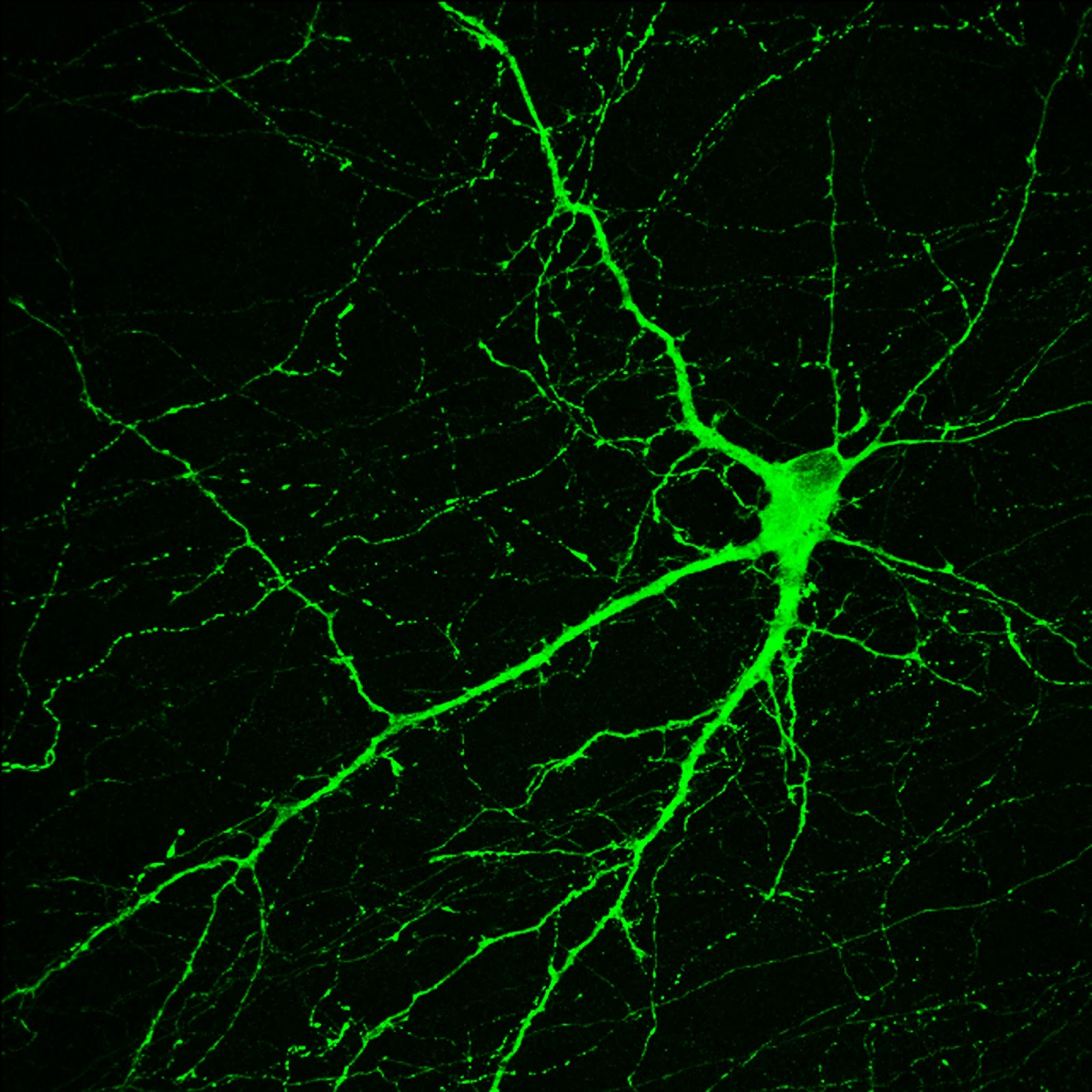
Caption: This neuron, created in the Su-Chun Zhang lab at the University of Wisconsin–Madison, makes dopamine, a neurotransmitter involved in normal movement. The cell originated in an induced pluripotent stem cell, which derive from adult tissues. Similar neurons survived and integrated normally after transplant into monkey brains—as a proof of principle that personalized medicine may one day treat Parkinson's disease. Date: 2010. Image: courtesy Yan Liu and Su-Chun Zhang, Waisman Center, University of Wisconsin–Madison.
The three monkeys involved in the experiment were given tiny lesions or scars in their brain to mimic Parkinson’s disease. Another lead researcher, Marina Emborg, commented on how the inserted cells integrated themselves into the brain. “After six months, to see no scar, that was the best part."
Because of these precautions, the experiment succeeded in introducing new cells into the monkey’s brains without any obvious problems. But in this experiment, too few cells were introduced to help the monkeys overcome the symptoms of Parkinson’s. Solving that problem is the obvious next step.
Wednesday, March 13, 2013
Enhancing Healthy Kids: A Warning, But Who's Listening?
Drugs like Ritalin and Adderal are widely used, not just by adults and university students, but increasingly by children, and not just those who are appropriately diagnosed as experience difficulites with attention or focus, such as Attention Deficit Disorder.
PHOTO: Ritalin SR (a brand-name sustained-release formulation of
methylphenidate, from Wikimedia, 16 June 2006, created by
Sponge. Perviously, the AAN raised concerns drug enhancement by adults. It concluded that there is no moral basis for objecting, provided that the patient is acting autonomously in requesting the prescription. But when it comes to prescribing for healthy children, the AAN report makes this claim: "Pediatric neuroenhancement remains a particularly unsettled and value-laden practice, often without appropriate goals or justification."
The Report notes that enhancing children is fundamentally different from enhancing adults. For doctors, it raises concerns for "the fiduciary responsibility of physicians caring for children, the special integrity of the doctor–child–parent relationship, the vulnerability of children to various forms of coercion, distributive justice in school settings, and the moral obligation of physicians to prevent misuse of medication."
Based on these concerns, the AAN Report advises that "the prescription of neuroenhancements is inadvisable because of numerous social, developmental, and professional integrity issues."
The primary objection raised by the AAN is that children lack the competency to act as autonomous moral agents. If they were competent, then their request for enhancement would be honored. Sure, children can be coerced, manipulated, confused, and ambivalent about their needs. Kind of like the rest of us.
Whether age brings moral competence is a good question. But perhaps what this report shows us once again is that when secular bioethics meets enhancement technology, about all it can say is this: If you want it and if you can prove your competence, you can have it.
Monday, January 30, 2012
Brain Stimulation and Human Cognitive Enhancement
Now it appears that simple electrical devices that stimulate the brain are able to enhance human cognitive performance.
An Essay in a recent issue of Current Biology describes recent advances in “non-invasive brain stimulation” (NIBS). One approach in particular—“transcranial direct current stimulation” or TDCS—is described in detail. According to the essay, TDCS is a simple tool that is “portable, painless, inexpensive, apparently safe, and with potential longterm efficacy.” It may be used to help those suffering from impaired cognitive abilities.
More to our point, however, is that TDCS shows remarkable potential for human enhancement. Simply put, this device seems to have the power to make normal children and adults smarter than they would normally be. To quote the essay, TDCS has the potential “to enhance fundamental human capacities, such as motor and sensorimotor skills, vision, decision making and problem solving, mathematical cognition, language, memory, and attention—improvements that seem to persist without apparent cognitive side effects.”
The main point of the essay is to invite broad discussion about the neuroethics of cognitive enhancement. A good deal of attention is focused on whether TDCS or similar techniques should be used on children. The authors argue that having smarter children will benefit everyone. Their conclusion: “If it is handled judiciously, TDCS could prove to be an inexpensive and widely-deployed technology with substantial benefits to individuals and society.”
Anyone following the debate about human enhancement will see this as further evidence that in terms of the technology, “the future is here.”
Sure, there’s a lot to think about here before we rush out and strap TDCS devices on our heads. Anyone worried that mobile phones pose a health risk will probably not think this is such a good idea.
But many of us human beings value our cognitive abilities above everything else. If TDCS is a safe way to become smarter, then why not?
According to the Christian tradition, human beings are created in the image of God. One way we resemble God is through the power of intellect, which we share with the animals but which we alone exhibit to such a lofty degree that we can be compared to God. According to Gregory of Nyssa, one of the great theologians of the fourth century, “The Deity beholds and hears all things, and searches all things out." No surprise there. But then Gregory adds: "You too have the power of apprehension of things by means of sight and hearing, and the understanding that inquires into things and searches them out.”
How expected that by inquiring into all things and searching them out, we now seem to be learning how to enhance the very power of thought and discovery.
If we enhance our intelligence will we become more like God? Not quite. Intelligence may be one way we can and should resemble God, but it's not the only way. In fact, intelligence by itself can be worrisome.
Much to his credit, Julian Savulescu (a co-author in the TDCS essay) is one of very few who has urged us to pay attention to the question of “moral enhancement.” Quite simply, smarter people who are not also morally better people may turn out to be very dangerous people. So after reading the essay on how to enhance cognition, let me suggest you look at a 2008 paper by Ingmar Persson and Julian Savulescu, entitled "THE PERILS OF COGNITIVE ENHANCEMENT AND THE URGENT IMPERATIVE TO ENHANCE THE MORAL CHARACTER OF HUMANITY."