Showing posts with label brain regeneration. Show all posts

Thursday, March 14, 2013

Stem Cell Advance: Brain Cells Inserted in Monkey Brains

Researchers at the University of Wisconsin-Madison are reporting a significant step forward toward the day when stem cells may be used to treat brain diseases such as Parkinson’s.

Working with three rhesus monkeys, the research team created a personalized stem cell culture for each monkey.  Cells taken from the skin of the monkey were induced to a state of pluripotency by means of a process called “induced pluripotency.”  Once in a state of pluripotency, the cells were guided forward in the process of differentiation until they became neurons and glial cells.  Along the way, the cells in the culture were given a genetic tag so the cells would glow under a florescent light. 
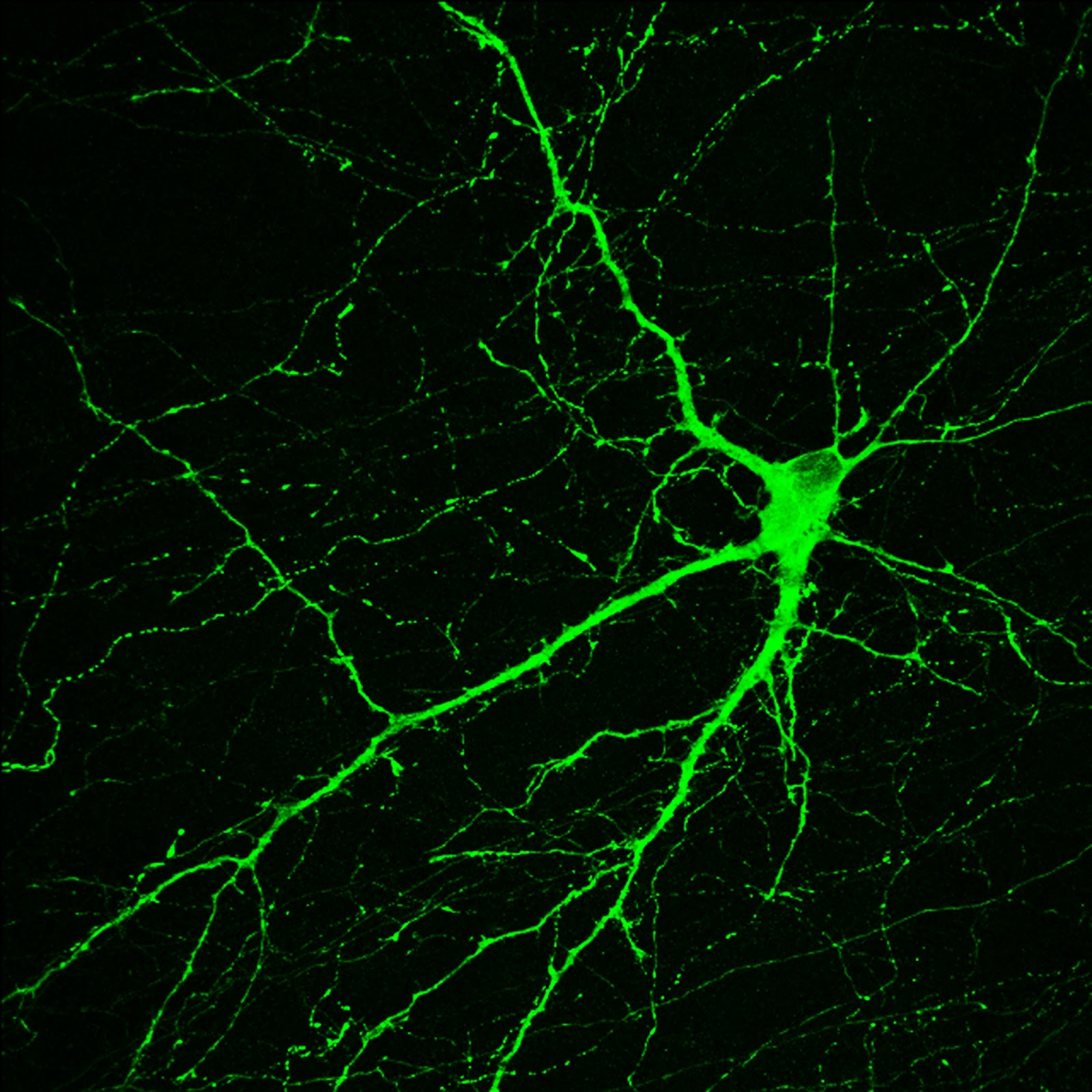
Then the cells were implanted in the brains of the rhesus monkeys.  Because the source of the cells was the monkeys themselves, the DNA matched and there was no immune reaction.  After six months, researchers discovered that the cells were so fully integrated into the monkey brains that in many cases, they could only be recognized by their green florescent glow.

"When you look at the brain, you cannot tell that it is a graft," says senior author Su-Chun Zhang, according to a press release from the University of Wisconsin. "Structurally the host brain looks like a normal brain; the graft can only be seen under the fluorescent microscope." 

Caption: This neuron, created in the Su-Chun Zhang lab at the University of Wisconsin–Madison, makes dopamine, a neurotransmitter involved in normal movement. The cell originated in an induced pluripotent stem cell, which derive from adult tissues. Similar neurons survived and integrated normally after transplant into monkey brains—as a proof of principle that personalized medicine may one day treat Parkinson's disease. Date: 2010.  Image: courtesy Yan Liu and Su-Chun Zhang, Waisman Center, University of Wisconsin–Madison.

The three monkeys involved in the experiment were given tiny lesions or scars in their brain to mimic Parkinson’s disease.  Another lead researcher, Marina Emborg, commented on how the inserted cells integrated themselves into the brain.  “After six months, to see no scar, that was the best part."


What makes this work significant is that it is the first use of induced pluripotent stem cells (iPS) involving a primate, setting the stage for further work someday involving human beings.  According to Zhang, "It's really the first-ever transplant of iPS cells from a non-human primate back into the same animal, not just in the brain," says Zhang. "I have not seen anybody transplanting reprogrammed iPS cells into the blood, the pancreas or anywhere else, into the same primate. This proof-of-principle study in primates presents hopes for personalized regenerative medicine."

One of the keys to their success is that the iPS cells themselves were not transplanted into the monkeys.  Because iPS cells are pluripotent, they can give rise to cancer or other problems.  In this work, the researchers carefully guided the iPS cells so that they were almost at the final stage of differentiation, and then made sure that their cell culture was completely purified so that no potentially cancer-causing cells would slip through.  Quoting Zhang once again: "We differentiate the stem cells only into neural cells. It would not work to transplant a cell population contaminated by non-neural cells."

Because of these precautions, the experiment succeeded in introducing new cells into the monkey’s brains without any obvious problems.  But in this experiment, too few cells were introduced to help the monkeys overcome the symptoms of Parkinson’s.  Solving that problem is the obvious next step.

According to the paper, “this finding represents a significant step toward personalized medicine,” which may someday be used to treat a wide range of diseases in humans.  Because the original source of the cells was from the individual monkeys themselves, there was no immune rejection.  If the same technique can be applied to human beings, it may mean that an individualized culture of iPS cells could be created for each patient, then carefully guided forward in the process of differentiation, and then implanted to regenerate organs or tissues damaged by injury or disease.

What makes iPS cells especially attractive is that no embryos are used in their creation, and so almost no one objects to this line of medical research.  But if regenerative medicine is successful, someday it will be used not just to treat disease but to off-set the effects of aging or to enhance those who are well.  Then, we can be sure, many will object to this technology, but even more will use it.

The article, entitled “Induced Pluripotent Stem Cell-DerivedNeural Cells Survive and Mature in the Nonhuman Primate Brain,” is freely available at the open access journal, Cell Reports in its March 28, 2013 issue. 


Friday, January 6, 2012

Hope for Aging Brains

When electrical wires lose their insulation, they have to be replaced. When the nerves and brain cells in our bodies lose theirs, they regenerate it naturally.

Up to a point, that is. As the decades pass, our bodies lose the ability to regenerate themselves. The results are obvious: wrinkled skin, weak muscles, and forgetful brains.

All the more tragic for those among us with diseases that attack the very processes of regeneration. Multiple sclerosis (MS), for example, keeps the body from restoring the insulating layers that protect nerve fibers. The insulation—“myelin”—breaks down naturally. In most human brains, “remyelination” is a constant process, rebuilding the myelin that protects the brain cells and allows them to do their work. For people with MS, remyelination is under attack.

Working with mice, researchers seem to have found a way to reinstate the remyelination process. In a report in the January 6 issue of Cell Stem Cell, researchers at Harvard and Cambridge Universities show that the capacity for remyelination can be restored in aging mice.

The cells that are responsible for remyelination are still present in the aging mouse. It’s just that they have been switched off. By exposing these cells to switching signals present in a much younger mouse, researchers were able to reverse the effects of aging on the cells that do the work of remyelination.

How did they do this? They literally joined the old and the young mouse together surgically. This allows their blood to circulate together. In the young blood, apparently, were various chemical signals that reset the switches in the cells of the brains of the aging mice. The result: spontaneous remyelination.

According to Robin Franklin, one of the researchers, the study shows that “age-associated decline in remyelination is reversible. We found that remyelination in old adult mice can be made to work as efficiently as it does in young adult mice.” Franklin, who is Director of the MS Society's Cambridge Centre for Myelin Repair at the University of Cambridge, made her comments in a press release issued by her university.

What’s perhaps most interesting about this report is that it is a kind of stem cell research that doesn’t implant stem cells. It works on the principle that stem cells already exist in the patient’s body but that they’ve been silenced by age or disease. They need to be switched back on or rejuvenated. According to Franklin, “remyelination therapies do not need to be based on stem cell transplantation since the stem cells already present in the brain and spinal cord can be made to regenerate myelin - regardless of the patient's age."

As interesting as this is, it is important to stress that this is a “proof of concept” study. The techniques here are simply not applicable to human beings. They are encouraging because they suggest that perhaps some day, researchers will discover just what it is in the young body that keeps it young. What are the specific factors that keep the body’s own stem cells switched on? And if it circulates in the blood as this study shows, perhaps these factors could simply be injected.

Of course, if researchers discover how to do this, it’s not just people with diseases like MS who will be interested. One of the interesting social features about this work is that it is funded in part by the UK MS Society and the American MS Society. In other words, the funding is motivated by the search for a cure for a very specific disease. But the mice is the study were aging, not ill. That suggests to me, at least, that the larger portion of the “beneficiaries” of this work will be aging humans, not those with MS. If so, then this study is one more step in the quest of human enhancement, suggesting that it may be possible to reverse aging in the one part of the body where it is most feared—the human brain.

The journal report ends with this comment: “Moreover, this work demonstrates that the CNS maintains its responsiveness to age-regulated circulatory factors, such that age-dependent deficiencies in repair of these tissues can, in part, be reversed by circulating factors.”

The paper, “Rejuvenation of regeneration in the aging central nervous system,”' is published in the January 6 issue of Cell Stem Cell.

Friday, November 25, 2011

Brain Regeneration: Mouse Brains and Human Futures

Embryonic stem cells are surprisingly capable of regenerating portions of the brains of mice according to a report published in the November 25 issue of the journal Science. What is unexpected about this report is not the extent of the repairs so much as where they occurred in the brain.

The hypothalamus, which is involved basic metabolism and complex behaviors, has usually been regarded as less open to regeneration, whether naturally or by biomedical intervention. Naturally, a limited number of neurons develop during adulthood, but these are not enough to restore this area of the brain after injury or disease. “The neurons that are added during adulthood in both regions are generally smallish and are thought to act a bit like volume controls over specific signaling,” explained Jeffrey Macklis of Harvard Medical School and one of the lead researchers in the study.

“Here we've rewired a high-level system of brain circuitry that does not naturally experience neurogenesis,” Macklis said, “and this restored substantially normal function.”

The report reached this conclusion: “these experiments demonstrate that synaptic integration… [by] donor neurons can impart an organism-level rescue of metabolic defects, thereby providing a proof of concept for cell-mediated repair of a neuronal circuit controlling a complex phenotype.”

While it is important to underscore that this work is performed on mice, the results suggest that something similar might be possible someday in human beings with brain injuries. “The finding that these embryonic cells are so efficient at integrating with the native neuronal circuitry makes us quite excited about the possibility of applying similar techniques to other neurological and psychiatric diseases of particular interest to our laboratory," according to Matthew Anderson in a press release issued by Harvard Medical School.

For now, research continues using mice as models for human disease or spinal cord injury. “The next step for us is to ask parallel questions of other parts of the brain and spinal cord, those involved in ALS and with spinal cord injuries,” according to Macklis. "In these cases, can we rebuild circuitry in the mammalian brain? I suspect that we can."

This study, coming so quickly on the heels of another report showing the functional integration of human embryonic stem cells into the mouse brain, suggests that embryonic stem cell research may indeed open new ways to treat brain disease or injury. Both studies, however, open the possibility that the use of technologies of brain regeneration will not stop with disease. As always, the growing power of medicine to treat disease is also an expansion of the possibility of human enhancement. All this if far in the future. But already, advocates of human enhancement have noticed its significance. See, for example, the re-posting of the original press release on Ray Kurweil's transhumanist blog.

The report, entitled “Transplanted Hypothalamic Neurons Restore Leptin Signaling and Ameliorate Obesity in db/db Mice,” appears in the November 25, 2011 issue of Science.